
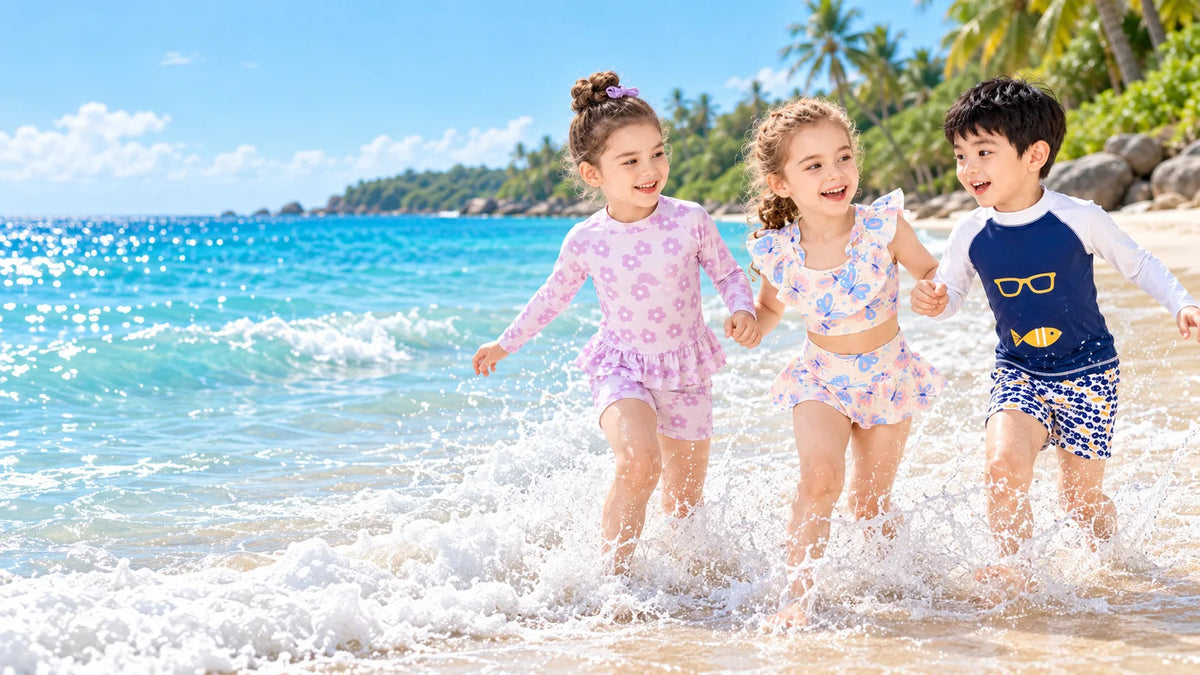
When you shop for sun-protective kids swimwear, you will often see a UPF 50+ label on swimsuits and rash guards. This guide explains what that rating means, why coverage still matters, and how to choose a style for the pool, the beach or swim lessons. It is general information for parents, not medical advice.
What UPF 50+ means on a kids swimsuit
The Skin Cancer Foundation describes ultraviolet protection factor (UPF) as a measure of how much UV radiation — both UVA and UVB — a fabric allows to reach the skin. On that page, a UPF 50 fabric is described as blocking 98 percent of the sun's rays, and UPF 50+ is described as excellent.
On MOMASONG product pages, UPF 50+ is used only for swimsuit and rash guard styles that list this rating. Many of our one-piece swimsuits and rash guards are UPF 50+; each product page shows whether a style has this rating. Test reports are available. Towels and water shoes are not described as UPF 50+.
How UPF is different from SPF
UPF and SPF are related ideas, but they are not the same. The Skin Cancer Foundation explains that UPF measures how much UV radiation can pass through fabric, and that it covers both UVA and UVB. SPF, used on sunscreen, is based on how long it takes UV-exposed skin to redden and measures UVB.
A UPF 50+ swimsuit or rash guard is a clothing rating for the fabric that covers the skin. It is not a substitute for the sunscreen you put on uncovered areas such as the face, ears, hands and the parts of the legs or arms a style leaves bare.
Coverage matters as much as the rating
A high UPF rating applies to the fabric itself. The more skin the swimsuit or rash guard covers, the less skin is left open to the sun. The American Academy of Pediatrics recommends clothing that is preferably long-sleeved and long-legged, along with hats, as part of a wider plan to reduce ultraviolet exposure.

The Skin Cancer Foundation also notes that clothing can lose some of its protective ability if it gets stretched or wet, and that loose-fitting clothes are preferable to tight ones that pull the fibers apart. That is one reason to check the fit, not only the label. For measurements and size charts, use our Kids Swimwear Size Guide and the parent article Kids Swimsuit Size Chart: How to Choose the Right Size.
How to choose a sun-protective style
Start with the day you have in mind — a lesson in an indoor pool, a long afternoon at the beach, or a mix of both — and then look at sleeves, neckline and whether you want a one-piece or a set. If a product is UPF 50+, that will be stated on its page.
Rash guards and long sleeves
A long-sleeve rash guard covers the shoulders, back and arms. It is a common choice for beach days and outdoor pools. Browse kids rash guards, including styles such as the girls UPF 50+ long sleeve baseball rash guard set and the boys UPF 50+ long sleeve rash guard swim set. For a closer look at rash guard features, see our existing guide, Kids Rash Guards: A UPF 50+ Buying Guide.

One-piece swimsuits
A one-piece stays in one piece during play and can cover the torso more simply than a two-piece. Short-sleeve and long-sleeve options both appear in our one-piece swimwear collection. The girls UPF 50+ short sleeve one-piece swimsuit and the boys UPF 50+ long sleeve shark one-piece rash guard swimsuit are examples of styles whose product pages list UPF 50+.


Two-piece sets
A rash guard set — a swim shirt with matching shorts or pants — can be easier to put on, and some families like being able to mix the pieces. See our two-piece swimwear collection, and girls and boys swimwear for the full range.
What UPF swimwear does not replace
Sun-protective clothing is one part of a broader routine. The American Academy of Pediatrics advises wearing water-resistant, broad-spectrum sunscreen with SPF 15 or higher on skin that clothing does not cover, applied at least 15 minutes before going outside and reapplied every two hours, or after swimming or sweating. The same guidance notes that shade or clouds reduce but do not eliminate exposure, recommends paying attention to the UV Index and avoiding peak hours of 10 a.m. to 4 p.m. when you can, and says infants younger than 6 months should be kept out of direct sunlight.
Use the swimsuit or rash guard together with shade and those other sun-safety practices. Check each product page for that style's rating, rather than assuming every piece in the cart is UPF 50+.
Frequently asked questions
What does UPF 50+ mean on a kids swimsuit?
UPF is a fabric rating for how much UV radiation reaches the skin through the garment. The Skin Cancer Foundation describes a UPF 50 fabric as blocking 98 percent of the sun's rays and rates UPF 50+ as excellent. On our site, this wording appears only on swimsuit and rash guard styles whose product pages list it.
Is UPF the same as SPF?
No. UPF measures UV radiation passing through fabric and includes UVA and UVB. SPF is the sunscreen rating and, as the Skin Cancer Foundation explains, is based on how long it takes skin to redden and measures UVB.
Does a UPF 50+ swimsuit replace sunscreen?
No. It covers the skin under the fabric. The American Academy of Pediatrics still recommends water-resistant, broad-spectrum sunscreen of SPF 15 or higher on uncovered skin, reapplied every two hours or after swimming or sweating.
Do kids still need sun protection in the shade?
Shade helps, but it does not remove the need for care. The American Academy of Pediatrics notes that shade or clouds reduce but do not eliminate ultraviolet exposure, and recommends sun safety even on cloudy days, in shady spots and during winter.
Which kids styles cover the most skin?
Long-sleeve rash guards, full-body or zip-up rash guard swimsuits, and one-pieces with higher necklines generally cover more than a sleeveless or short-sleeve style. Compare the photos and description on each product page, and use the size guide so the garment sits as intended.
How do I know if a MOMASONG style is UPF 50+?
Read the product title and description. Many swimsuit and rash guard styles are UPF 50+, but not every item on the site is. If the page does not say UPF 50+, do not assume that rating. Test reports are available if you need them.
Looking for a boys long-sleeve set next? Start with our rash guards and the boys long sleeve rash guard swim set, whose product page lists UPF 50+.